Prescribing Information Visit Patient website

Alleviate itch. 
Accelerate relief.

Not an actual patient.

The FIRST AND ONLY FDA-approved treatment specifically developed and indicated for cholestatic pruritus in PBC1,2

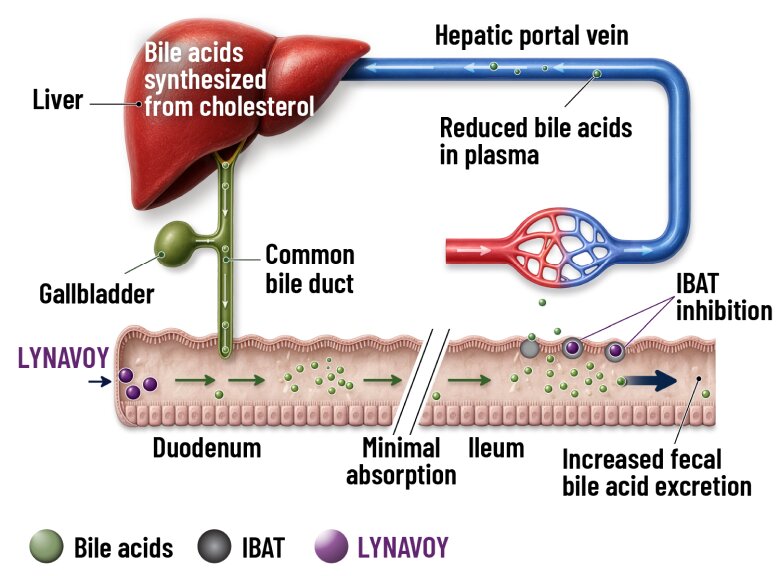
LYNAVOY is a potent and selective IBAT inhibitor believed to treat a root cause of itch1,3,4

LYNAVOY works through reversible IBAT inhibition, limiting bile acid absorption
in the terminal ileum.1*

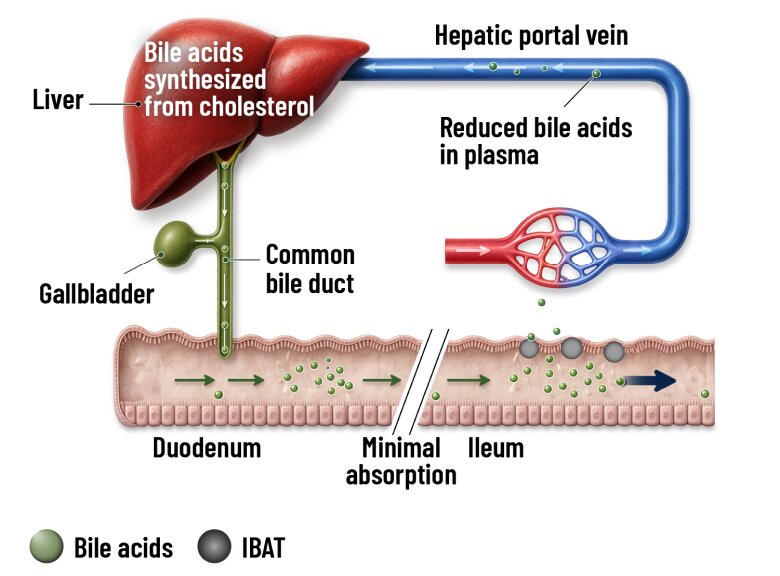
Diagram of bile acid circulation between the liver and the intestine before LYNAVOY

Adapted from Naumann S, et al. Int J Mol Sci. 2020;21(18):6495. Permitted under Creative Commons Attribution 4.0 International License

Through targeting bile acid recycling, LYNAVOY supports greater fecal elimination of bile acids1,5

*Although the exact mechanism is unknown, LYNAVOY may reduce pruritus in PBC by inhibiting IBAT and lowering serum bile acid levels associated with itch.1

FDA=Food and Drug Administration; IBAT=ileal bile acid transporter; PBC=primary biliary cholangitis.

See LYNAVOY Safety

Important Safety Information

Warnings and Precautions

Liver Test Elevations were observed more commonly in LYNAVOY-treated patients compared to placebo-treated patients.

  • Obtain baseline liver tests (alanine aminotransferase [ALT], aspartate aminotransferase [AST], total bilirubin [TB], direct bilirubin [DB], alkaline phosphatase [ALP]) prior to initiating treatment with LYNAVOY and monitor the levels per standard clinical practice for PBC patients during treatment with LYNAVOY.
  • If new liver test elevations occur, monitor ALT, AST, TB, DB, and ALP more frequently.
  • If liver test elevations persist, discontinue LYNAVOY.

Diarrhea was reported as the most common adverse reaction in patients treated with LYNAVOY.

  • If diarrhea occurs, advise patients to monitor for dehydration.
  • Consider interrupting or discontinuing LYNAVOY treatment if diarrhea persists.

Fat-Soluble Vitamin (FSV) Deficiency: LYNAVOY may adversely affect absorption of FSV (i.e., vitamins A, D, E, and K).

  • Obtain serum levels for vitamins A, D, and E and INR prior to initiation of LYNAVOY.
  • Monitor the levels periodically during treatment, along with any clinical manifestations of FSV deficiency.
  • Supplement with FSV if a deficiency is diagnosed.
  • Consider discontinuing LYNAVOY if FSV deficiency persists or worsens despite adequate supplementation.
  • Bleeding was observed more frequently in LYNAVOY-treated patients compared to placebo-treated patients.
    • If bleeding occurs, interrupt LYNAVOY treatment and evaluate for potential FSV deficiency.
    • LYNAVOY can be restarted if FSV deficiency is corrected, levels are maintained, and bleeding has resolved.
  • Bone Fracture has been associated with IBAT inhibitors.
    • Monitor bone health and ensure adequate FSV levels.

Adverse Reactions

The most common adverse reactions (≥5%) are diarrhea, abdominal pain, nausea, increased ALT, hemorrhage, increased AST, headache, dyspepsia, gastroesophageal reflux disease, abdominal distension, dizziness, and arthralgia.

Drug Interactions

  • Effect of Bile Acid Binding Resins on LYNAVOY: Administer at least 4 hours before or 4 hours after administration of LYNAVOY.

To report SUSPECTED ADVERSE REACTIONS, contact Intercept Pharmaceuticals 1-844-782-4278 or FDA at 1-800-FDA-1088 or www.fda.gov/medwatch

Please see the full Prescribing Information for LYNAVOY.

Indication:

LYNAVOY (linerixibat) is an ileal bile acid transporter (IBAT) inhibitor indicated for the treatment of cholestatic pruritus associated with primary biliary cholangitis (PBC) in adult patients.

Limitations of Use: Avoid use of LYNAVOY in patients with decompensated cirrhosis or those with prior or active hepatic decompensation events (e.g. variceal hemorrhage, ascites, hepatic encephalopathy).

References

  1. 1. LYNAVOY (linerixibat) Prescribing Information. Morristown, NJ: Intercept Pharmaceuticals.
  2. 2. Alfasigma. Linerixibat approved for use in the U.S. for the treatment of cholestatic pruritus in primary biliary cholangitis (PBC). Press release. March 19, 2026. Accessed October 6, 2026. https://alfasigma.com/news-media/linerixibat-approved-for-use-in-the-u-s-for-the-treatment-of-cholestatic-pruritus-in-primary-biliary-cholangitis-pbc
  3. 3. Kode V, Yimam KK. Cholestatic pruritus: pathophysiology, current management approach, and emerging therapies. Current Hepatology Reports. 2024;23(1):123-136. doi:10.1007/s11901-024-00638-7
  4. 4. Hegade VS, Kendrick SF, Dobbins RL, et al. Effect of ileal bile acid transporter inhibitor GSK2330672 on pruritus in primary biliary cholangitis: a double-blind, randomised, placebo-controlled, crossover, phase 2a study. Lancet. 2017;389(10074):1114-1123. doi:10.1016/S0140-6736(17)30319-7
  5. 5. Naumann S, Haller D, Eisner P, Schweiggert-Weisz U. Mechanisms of interactions between bile acids and plant compounds-a review. Int J Mol Sci. 2020;21(18):6495. doi:10.3390/ijms21186495
  6. 6. Food and Drug Administration. LYNAVOY (linerixibat) NDA 220295: Integrated Review. Published 2026. Accessed August 4, 2026. https://www.accessdata.fda.gov/drugsatfda_docs/nda/2026/220295Orig1s000IntegratedR.pdf
  7. 7. Hirschfield GM, Bowlus CL, Jones DEJ, et al. Linerixibat in patients with primary biliary cholangitis and cholestatic pruritus (GLISTEN): a randomised, multicentre, double-blind, placebo-controlled, phase 3 trial. Lancet Gastroenterol Hepatol. 2026;11(1):22-33. doi:10.1016/S2468-1253(25)00192-X
  8. 8. Bowlus L. Long-term safety, tolerability and maintenance of efficacy of linerixibat for the treatment of cholestatic pruritus in primary biliary cholangitis: An interim analysis. Poster presented at: EASL 2026; May 27-30, 2026; Barcelona, Spain.
  9. 9. Bowlus CL, Gordon SC, Jones DE, et al. TOP-280: Long-term safety, tolerability and maintenance of efficacy of linerixibat for the treatment of cholestatic pruritus in primary biliary cholangitis. J Hepatol. 2026;84(suppl 1):S295-S296. doi:10.1016/ S0168-8278(26/00974-8
  10. 10. Hirschfield GM. Supplement to: Linerixibat in patients with primary biliary cholangitis and cholestatic pruritus (GLISTEN): a randomised, multicentre, double-blind, placebo-controlled, phase 3 trial. Lancet Gastroenterol Hepatol. 2026;11(1):22-33. doi:10.1016/S2468-1253(25/00192-X