Improvement in itch relief and itch-related sleep disruption

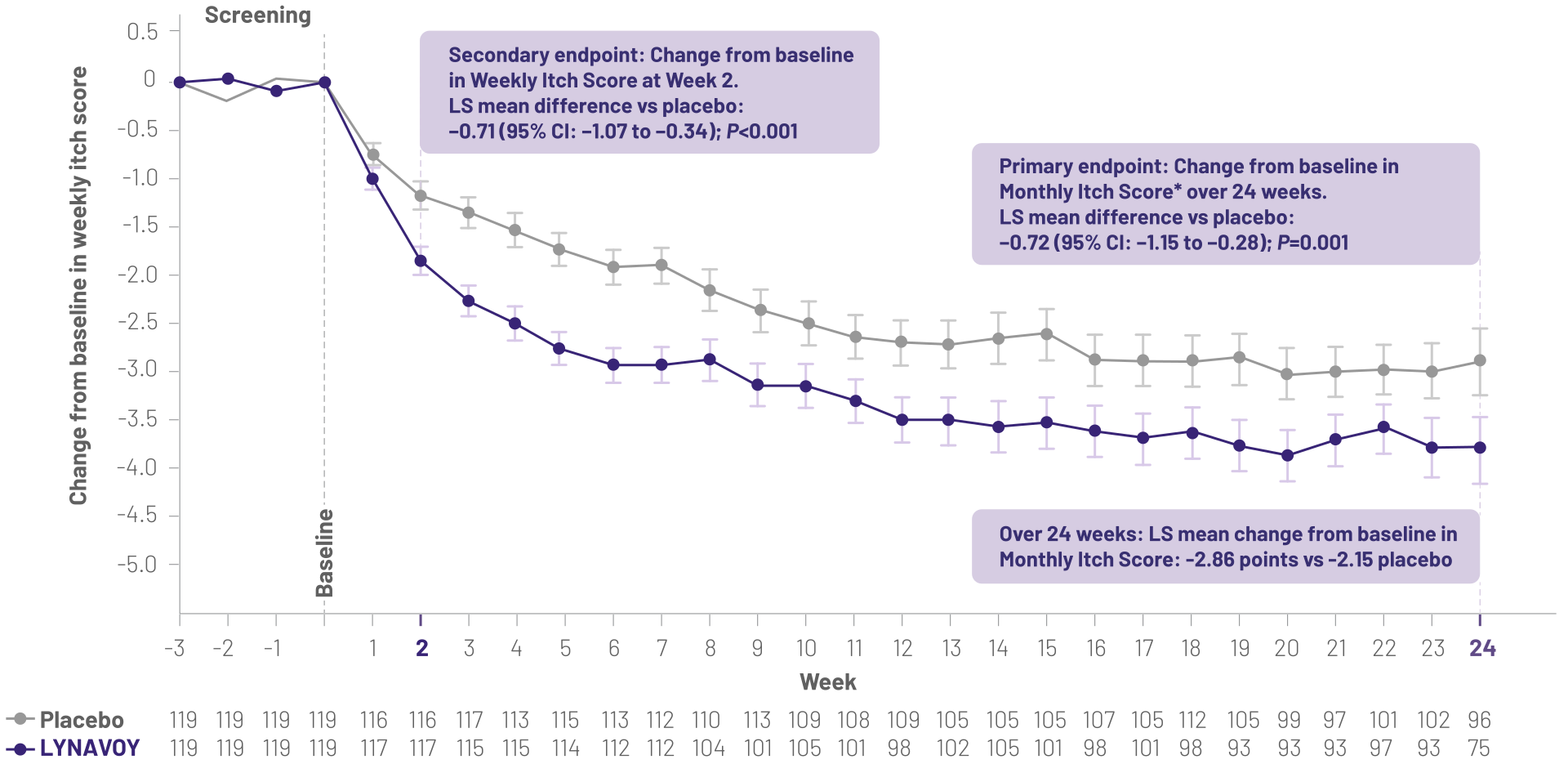
Rapid itch relief as early as 2 weeks, sustained through 24 weeks (vs placebo)1

Change from baseline in Mean Weekly Itch Score* over 24 weeks6,7
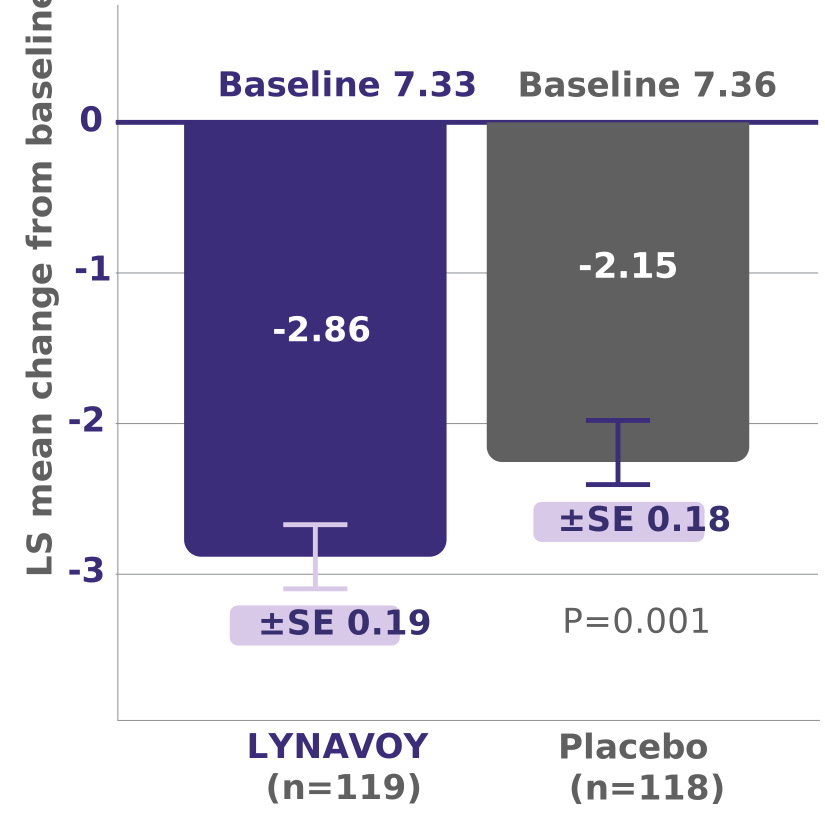
graph showing change in monthly itch score from baseline over 24 weeks
  • Primary endpoint: Change from baseline in Monthly Itch Score* over 24 weeks. LS mean difference vs placebo: -0.72 (95% CI: -1.15 to -0.28); P=0.001
  • Secondary endpoint: Change from baseline in Weekly Itch Score at Week 2. LS mean difference vs placebo: -0.7 (95% CI: -1.07 to -0.34); P<0.001
  • Greater itch improvement over 24 weeks1
  • Rapid itch relief at Week 21
  • Sustained itch relief through Week 241

*The Monthly Itch Score was computed as the worst (highest) Weekly Itch Score within a 4-week period.

Significant improvement in itch-related sleep interference

Only treatment demonstrated to improve itch-related sleep interference

Change from baseline in Monthly Sleep Score over 24 weeks1

graph showing change in monthly sleep score from baseline over 24 weeks

Secondary endpoint: Change in Monthly Sleep Score over 24 weeks1

  • Statistically significant improvement from baseline vs placebo over 24 weeks
  • LS mean difference vs placebo: -0.53 (95% CI: -0.98 to -0.07); P=0.024

LYNAVOY was studied in GLISTEN, a randomized, double-blind, placebo-controlled Phase 3 study1,6

study design of LYNAVOY

At baseline, 97% of patients were receiving UDCA and 47% were receiving concomitant antipruritic drugs

  • Patient demographics: Mean Age: 55.8 years (range: 30-80); Gender: 95% female
  • Race/ethnicity: 62% White, 30% Asian, 3% American Indian or Alaskan Native, <1% Black, 23% Hispanic or Latino

Itch and sleep assessments1
itch icon

Itch assessment: Patients rated their worst itch severity each morning and evening using the 11-point Worst Itch NRS (0=no itch; 10=worst imaginable itch).

  • Worst Daily Itch Score: Highest of the two scores (morning or evening) recorded in a day
  • Weekly Itch Score: Average of the Worst Daily Itch Scores over 7 days
  • Monthly Itch Score: Worst (highest) Weekly Itch Score within a 4-week period
sleep icon

Sleep assessment: Patients rated pruritus-related sleep interference each morning using the 11-point Sleep Interference NRS (0=no interference; 10=complete interference).

  • Weekly Sleep Score: Average of the Daily Sleep Scores recorded over the 7 days in a week
  • Monthly Sleep Score: The worst (highest) Weekly Sleep Score within a 4-week period

CI=confidence interval; GLISTEN=Global Linerixibat Itch STudy of Efficacy and Safety iN primary biliary cholangitis; LS=least-squares; NRS=Numeric Rating Scale; SE=standard error; UDCA=ursodeoxycholic acid.

Important Safety Information

Warnings and Precautions

Liver Test Elevations were observed more commonly in LYNAVOY-treated patients compared to placebo-treated patients.

  • Obtain baseline liver tests (alanine aminotransferase [ALT], aspartate aminotransferase [AST], total bilirubin [TB], direct bilirubin [DB], alkaline phosphatase [ALP]) prior to initiating treatment with LYNAVOY and monitor the levels per standard clinical practice for PBC patients during treatment with LYNAVOY.
  • If new liver test elevations occur, monitor ALT, AST, TB, DB, and ALP more frequently.
  • If liver test elevations persist, discontinue LYNAVOY.

Diarrhea was reported as the most common adverse reaction in patients treated with LYNAVOY.

  • If diarrhea occurs, advise patients to monitor for dehydration.
  • Consider interrupting or discontinuing LYNAVOY treatment if diarrhea persists.

Fat-Soluble Vitamin (FSV) Deficiency: LYNAVOY may adversely affect absorption of FSV (i.e., vitamins A, D, E, and K).

  • Obtain serum levels for vitamins A, D, and E and INR prior to initiation of LYNAVOY.
  • Monitor the levels periodically during treatment, along with any clinical manifestations of FSV deficiency.
  • Supplement with FSV if a deficiency is diagnosed.
  • Consider discontinuing LYNAVOY if FSV deficiency persists or worsens despite adequate supplementation.
  • Bleeding was observed more frequently in LYNAVOY-treated patients compared to placebo-treated patients.
    • If bleeding occurs, interrupt LYNAVOY treatment and evaluate for potential FSV deficiency.
    • LYNAVOY can be restarted if FSV deficiency is corrected, levels are maintained, and bleeding has resolved.
  • Bone Fracture has been associated with IBAT inhibitors.
    • Monitor bone health and ensure adequate FSV levels.

Adverse Reactions

The most common adverse reactions (≥5%) are diarrhea, abdominal pain, nausea, increased ALT, hemorrhage, increased AST, headache, dyspepsia, gastroesophageal reflux disease, abdominal distension, dizziness, and arthralgia.

Drug Interactions

  • Effect of Bile Acid Binding Resins on LYNAVOY: Administer at least 4 hours before or 4 hours after administration of LYNAVOY.

To report SUSPECTED ADVERSE REACTIONS, contact Intercept Pharmaceuticals 1-844-782-4278 or FDA at 1-800-FDA-1088 or www.fda.gov/medwatch

Please see the full Prescribing Information for LYNAVOY.

Indication:

LYNAVOY (linerixibat) is an ileal bile acid transporter (IBAT) inhibitor indicated for the treatment of cholestatic pruritus associated with primary biliary cholangitis (PBC) in adult patients.

Limitations of Use: Avoid use of LYNAVOY in patients with decompensated cirrhosis or those with prior or active hepatic decompensation events (e.g. variceal hemorrhage, ascites, hepatic encephalopathy).

References

  1. 1. LYNAVOY (linerixibat) Prescribing Information. Morristown, NJ: Intercept Pharmaceuticals. 2026.
  2. 2. Alfasigma. Linerixibat approved for use in the U.S. for the treatment of cholestatic pruritus in primary biliary cholangitis (PBC). Press release. March 19, 2026. Accessed June 3, 2026. https://www.alfasigma.com/corporate/linerixibat-approved-for-use-in-the-u-s-for-the-treatment-of-cholestatic-pruritus-in-primary-biliary-cholangitis-pbc/
  3. 3. Hegade VS, Kendrick SFW, Dobbins RL, et al. Effect of ileal bile acid transporter inhibitor GSK2330672 on pruritus in primary biliary cholangitis: a double blind, randomised, placebo-controlled, crossover, phase 2a study. Lancet. 2017;389(10074):1114-1123. doi:1016/S0140-6736(17)30319-7
  4. 4. Kode V, Yimam KK. Cholestatic pruritus: pathophysiology, current management approach, and emerging therapies. Curr Hepatol Rep. 2024;23(19):1-14. doi:10.1007/s11901-024-00638-7
  5. 5. Naumann S, Haller D, Eisner P, Schweiggert-Weisz U. Mechanisms of interactions between bile acids and plant compounds—a review. Int J Mol Sci. 2020;21(18):6495. doi:10.3390/ijms21186495
  6. 6. Hirschfield GM, Bowlus CL, Jones DEJ, et al. Linerixibat in patients with primary biliary cholangitis and cholestatic pruritus (GLISTEN): a randomised, multicentre, double-blind, placebo-controlled, phase 3 trial. Lancet Gastroenterol Hepatol. 2026;11(1):22-33. doi:10.1016/S2468-1253(25)00192-X
  7. 7. Data on File. Intercept Pharmaceuticals, Inc.